
Everything Revolved Around Engineering. Not Anymore.
AI is collapsing the cost of building software. Here is what that unlocks and what it puts at risk

For the last three decades, software economics was simple.
Building was expensive
Engineering dominated the P&L, and
Everything else bent around it
That logic made sense.
But not anymore
AI is collapsing the cost of building software.
What once took months to write, test, and deploy can now happen in hours.
When build stops being the dominant constraint, capital reallocates and the economic frontier expands with it.
For CPOs, this expansion signals three structural changes:
Value inside the software delivery lifecycle is moving
Entire categories of bets are becoming economically viable.
And new forms of fragility are emerging
To understand what’s shifting, start with where money is moving
Most organizations operate inside the same basic software delivery lifecycle:
Strategy → Discovery → Requirements → Design → Build → Ship → Learn → Strategy
On paper, this looks balanced. In reality, it never was.
If you mapped actual budget allocation inside most organizations, it would look roughly like this:
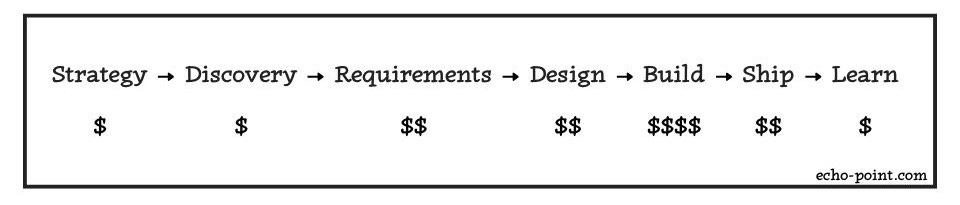
Build absorbed the majority of economic weight. Everything else optimized around it.
But as the marginal cost of build declines, that weight begins to shift. Value is moving upstream and downstream of build:
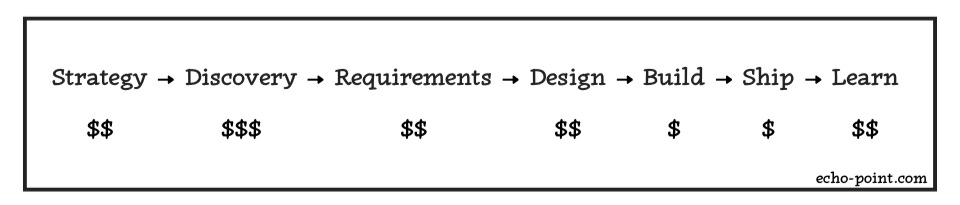
Build does not disappear. It will simply stop being the constraint the organization was built around
And when that happens, entirely new possibilities open up.
A new set of moves is now on the table
When build stops being the dominant constraint, portfolio logic begins to change.
For most CPOs, that’s a disorienting shift. The entire operating model was built assuming the build was expensive.
When that assumption begins to break, the organizations that recognize it first will move differently.
Here’s what it unlocks.
1. The minimum viable market just got a lot smaller
You no longer need massive markets to justify investment.
Now you can:
Serve micro-verticals
Target narrow use cases
Build for highly specialized customer cohorts
Instead of competing for broad market share, organizations can assemble portfolios of narrowly defined dominance.
For example, a retailer can launch digital offerings targeted at a highly specific customer cohort — something previously too narrow to justify dedicated investment.
2. One product for one customer is no longer crazy
You no longer have to standardize to scale.
Now you can:
Tailor workflows for specific customers, not just industries
Build custom feature sets for high-value accounts
Adapt interfaces and workflows down to departments
Instead of building one product for many, organizations can build many differentiated variations for each strategic customer.
For example, a SaaS company can effectively build a product for one. Adapting its software for a major customer without spawning an entirely separate product line.
3. You no longer have to pick one future
Strategy is becoming less of a commitment and more of a portfolio.
Now you can:
Test multiple business models in parallel
Launch adjacent product bets without multi-year commitments
Explore new markets without restructuring the core organization
Instead of committing to one long-range roadmap, organizations can manage a portfolio of strategic options.
For example, a financial institution can launch and test multiple digital services simultaneously. Validating demand before committing significant capital.
4. Every integration you depend on is now a build decision
You no longer have to rely on partners to extend your capabilities.
Now you can:
Build workflow layers that once lived outside your organization
Internalize extensions instead of integrating them
Expand into adjacent parts of the value chain
Instead of coordinating across multiple vendors, organizations can control more of the experience end-to-end. And capture a larger share of the margin.
For example, a retailer can build its own fulfillment optimization tools rather than relying entirely on third-party platforms, reducing dependency while strengthening control.
5. The white space your competitors hid in just disappeared
You no longer have to compete narrowly.
Now you can:
Expand into adjacent use cases quickly
Close feature gaps before they widen
Move into competitor white space with speed
Instead of competing in one lane, organizations can expand their surface area across the category.
For example, a healthcare platform can rapidly add adjacent services that once required independent vendors. Eliminating the white space that smaller players relied on to survive.
But the same shift that creates opportunity, also creates risk
The advantages above cut both ways.
While optionality expands, so does instability.
As a result, three new fault lines are emerging.
1. When everything is viable, focus collapses
When launching becomes cheap, strategy drifts invisibly.
More markets are viable.
More customization is possible.
More experiments clear ROI math.
The danger isn’t underinvestment. It’s diffusion.
Optionality expands faster than leadership discipline.
Organizations slowly lose focus, not because they move too slowly, but because they move in too many directions.
2. Your competitive advantage expires next quarter
When it becomes easier to build, it becomes easier for others to copy.
Feature gaps close quickly.
Adjacencies fill fast.
White space shrinks.
Advantages that once lasted years can disappear in quarters.
You don’t lose because you can’t execute. You lose because what you build doesn’t stay unique long enough to matter.
3. Bad decisions used to die slowly, now they ship
When build was the bottleneck, bad ideas died slowly. Now they ship instantly.
Poor prioritization.
Weak strategy.
Misread markets.
All show up much faster than before.
Organizations that misjudge direction won’t fail gradually. They will accelerate in the wrong direction.
Bottom line
Software economics are changing.
The constraint is moving.
Organizations that recognize the shift early will make decisions competitors cannot easily unwind.
The question for every CPO is simple.
Are you still organized around a cost center that is losing dominance? Or are you already reallocating toward what will determine advantage next: judgment, discovery, and the ability to move before the market forces you to?
The window is opening. The organizations that move first will define what comes next.
Building an AI-empowered product organization?
Curious what actually works and what doesn’t? Let’s talk.