

AI will not be limited by what it can do.
It will be limited by what people are willing to trust.
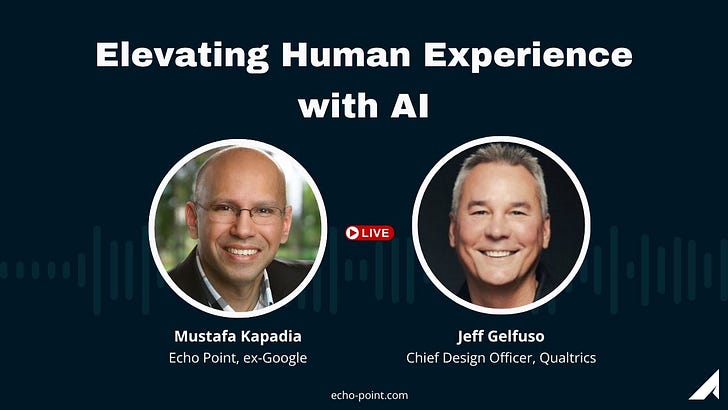
Jeff Gelfuso, Chief Product, Design, and Experience Officer at Qualtrics is seeing this firsthand as feedback systems move from passive measurement to active decision making. Systems that summarize input, recommend actions, and increasingly act on a company’s behalf.
In that world, accuracy isn’t enough.
The system has to be trusted. Where the insight came from. How it was formed. Whether it can be relied on when the decision actually matters.
For Jeff, trust isn’t a philosophical concern or a future problem.
It’s the practical bottleneck that determines whether AI becomes embedded in real product experience workflows or stays stuck as an impressive demo.
Here’s Jeff in His Own Words
The greatest barrier to adoption of AI into our products right now is trust.
Do I trust it? Do I trust that it’s giving me accurate information from the right sources? Do I trust it to act on my behalf?
You’re no longer evaluating what the system can do. When you’re making real business decisions based on this data, you have to be able to trust it.”
Watch the full interview with Jeff Gelfuso
Here’s what we talked about:
Why trust, not technical capability, is the real constraint on AI adoption
Moving from after-the-fact feedback to in-the-moment experience intervention
Turning surveys into conversations that increase signal, not noise
Acting on customer and employee feedback while the experience is still unfolding
Using synthetic panels to explore sensitive decisions and hard-to-reach audiences
The trust risks of agentic systems and AI acting on a company’s behalf
Designing AI products for ambiguity, edge cases, and evolving data
How conversational interfaces are reshaping how leaders consume insight
Shifting product organizations from roles and handoffs to outcomes and speed
What it means to operate in the “messy middle” of AI-driven transformation
Building an AI-empowered product organization?
Curious what actually works and what doesn’t? Let’s talk.


